Monday, January 29, 2018

2018 Book List


JAN - THE ART OF CRASH LANDING by Melissa DeCarlo (Jonna)


FEB (Nat'l Black History Month) - HOMEGOING by Yaa Gyasi (Gem)


MAR - WALDEN by Henry David Thoreau (Durren)


APR (Nat'l Poetry Month) - THE BOOK OF QUESTIONS by Pablo Neruda (Jerry)


MAY - Writings* of Kazuo Ishiguro (Paul)


JUN - THE WARMTH OF OTHER SUNS by Isabel Wilkerson (Huey)


JUL - THE ABSOLUTELY TRUE DIARY OF A PART-TIME INDIAN by Sherman Alexie (James)


AUG - WAS by Geoff Ryman (Durren)


SEP (Nat'l Banned Books Month) - WELCOME TO THE MONKEY HOUSE by Kurt Vonnegut (Jonna)


OCT - HIDDEN FIGURES by Margo Lee Shetterly (Trudy)


NOV - FANTASYLAND by Kurt Andersen (Brad)

Sunday, January 29, 2017

2017 Book List


JAN

CASSANDRA AT THE WEDDING by Dorothy Baker


FEB National AA History Month

MARCH (Book One) by Congressman John Lewis


MAR

AT THE EXISTENTIALIST CAFE by Sarah Bakewell


APR National Poetry Month

BORN PALESTINIAN, BORN BLACK by Suheir Hammad


MAY Short Fiction

OBLIVION by David Foster Wallace


JUN

STORK MOUNTAIN by Miroslav Penkov


JUL

TRUMP: The Art of the Deal by Donald J. Trump


AUG

THE PLOT AGAINST AMERICA by Philip Roth


SEP National Banned Books Month

STRANGE FRUIT by Lillian Smith


OCT

LINCOLN IN THE BARDO by George Saunders


NOV

NUTSHELL by Ian McEwan

Monday, March 14, 2016

To Kill a Mockingbird, by Harper Lee

March Meeting 2016

1. Analyze and evaluate Atticus Finch as a symbolic character.
2. Discuss Miss Maudie Atkinson as a non-stereotypical Southern lady.
3. Although Dill is a relatively minor character, discuss his impact on the development of the plot.
4. The author eventually merges two narrative strands as the bases for the plot. In view of these two strands, discuss the appropriateness of Lee's title choice.
5. What other themes, besides prejudice and injustice, does the author develop in the novel?
6. The author once commented that she considered the novel to be "a simple love story." Do you agree or disagree?
7. Other reactions/observations/comments?

Sunday, February 14, 2016

A Gathering Of Old Men, by Ernest J. Gaines


February Meeting 2016

1) What was your overall opinion of the novel?


2) Each chapter of the novel is told by a different narrator. Discuss the effect that this narrative technique creates. To what purpose does it serve?


3) Many of the old men express gratitude for the fact that they can confess to Beau's murder, even though they did not kill him. Why would they feel grateful when they could be possibly punished for their confessions?


4) Reverend Jameson - The one black character who refuses to go along with Candy's plan, why?

5) What significance does the label “Salt and Pepper” have in regards to the overall meaning of the story and the interactions between the characters?

6) What do you think of the judge's final verdict? Why does the author choose to close the book with a comical courtroom scene after dealing with such serious issues?

Monday, January 18, 2016

A Man Called Ove, by Fredrik Backman

January's book is A MAN CALLED OVE by Fredrik Backman, originally published in Sweden. It may be a more light-hearted book than we're accustomed to in this book club, but it packs more of a wallop than you might expect. And I thought it would be a perfect read over the busy holidays.

I have noticed that the reviews, etc. on the web reveal way too much, about the character and the plot, information that I think might've ruined it for me if I'd known it before I read the book.

It's kinda like the night our family sat down to watch Thelma & Louise years ago. I said "I love watching a movie I know absolutely nothing about," and Durren replied "All I know is they die in the end."

Gee, I hope you've all seen Thelma & Louise by now!!

I picked this book for January because we are all so busy during the holidays and might not have been able to read a heavier book. And because I thought it expressed the love and joy that the season is all about. It's a good thing I did because these questions would probably be even later than they are! I'm looking forward to hearing your thoughts about it and hope to see everyone there.

Also, my Aunt Nancy and Uncle Ralph are back in town and will be joining us again - they love our book club! And I believe Trudy is bringing a guest as well. Since we'll have guests, let's present a more Parveneh than Ove attitude!! Just kidding, we're wonderful all the time!!

Jonna

1. I may be the only one, but I like to get a general assessment at the beginning of the meeting. So, how many of you loved Ove?

2. We all know our own grumpy old men (not that 59 is old, mind you). Which of Ove's values do you agree of disagree with? Which of his pet peeves do you share?

3. As readers, we get to know Ove slowly, with his past revealed piece by piece. What surprised you about Ove's past? What piece of his past do you think had the most profound influence on Ove's personality / belief system?

4. Ove loves things that have a purpose, that are useful. How does this worldview fail him when he believes himself to be useless?

5. Parveneh seems to share his wife Sonja's near opposite approach to life, and both seem to have seen something in him that brought out what was in his heart, saving his life, in Parveneh's case (not to mention the others - Pat the Lanky One, the 7-year old, Nasanin, Anita, Adrian, Mirsad). Why do you think that is? Is it simply because he felt needed again? Or is he more motivated by his desire to please his Sonja, even after her death?

6. On page 246, the author muses that when people don't share sorrow, it can drive them apart. Do you agree? Why or why not?

Sunday, January 3, 2016

2016 Book List


JAN - Jonna - A MAN CALLED OVE by Fredrik Backman


FEB - Huey - Black History Month - A GATHERING OF OLD MEN by Ernest J. Gaines


MAR - Donna - TO KILL A MOCKINGBIRD by Harper Lee


APR - Paul - Poetry Month - HALF OF THE WORLD IN LIGHT by Juan Felipe Herrera


MAY - James - GO SET A WATCHMAN by Harper Lee


JUN - Dick - ONLY WHAT WE COULD CARRY by Lawson Fusao Inada


JUL - Sky - Short Stories - VAMPIRES IN THE LEMON GROVE by Karen Russell


AUG - Trudy - THE CHANGELING by Joy Williams


SEP - Jonna - Banned Books Month - THEIR EYES WERE WATCHING GOD by Zora Neale Hurston


OCT - Durren - EVENING by Susan Minot


NOV - Linda - ALL THE LIGHT WE CANNOT SEE by Anthony Doerr


DEC - Our "WE DID IT!!" Party

Tuesday, August 25, 2015

Lamb, by Christopher Moore

Brad Echols is our monitor this next Tuesday, when we'll have a great time discussing LAMB by Christopher Moore! His questions below.

On a side note, Eddie Bills, author of THE 1910 SLOCUM MASSACRE that we read in February, will be at the East Texas Book Festival in Tyler from 9:30 to 5:00 tomorrow (Sat 2015-08-22).

Lamb Questions

1. If you had to describe Lamb in two words, what would they be?

2. What did you think of the portrayal of Jesus/Joshua in Lamb? Sacrilegious? Reverential? Something in between? Does his relationship with Biff give him a different dimensionality?

3. Is Biff a realistic character, a literary device, both or neither?

4. Lamb and Christopher Moore's works in general are often classified as "absurdist humor." Do you agree with that label? Which scene, sequence or situations was the funniest to you? Did anyone find his humor sophomoric at times (as some critics of his work do)?

5. Does Lamb have something serious to say?

6. What is Lamb's greatest strength and its biggest weakness?

7. Will you read more Moore?

Thursday, June 25, 2015

The Railway Man, by Eric Lomax

The Railway Man

Questions provided by Dick Smith

1. What did you think of the book? Why do you think Lomax wrote the book? What is your assessment of his writing; presentation, story line, descriptions, details and flow?

2. The story appears to be in three sequential segments - (1) pre-war experiences, (2) military and POW experiences and (3) post-war experiences. What was your reaction to each of the segments?

3. Did you get a different understanding of the war in S.E. Asia and the treatment of military prisoners by the Japanese from reading the book?

4. Did Lomax's post war symptoms appear to be what we now refer to as PTSD?

Discuss your understanding of why most WW II veterans refused to talk about their experiences.How did the attitudes of those "back home" toward the war influence both veteran and civilian responses?

5. Lomax raises the issue about how little of the S.E. Asia war is included in post war writing and documentation of experiences in contrast to that which occurred in Europe? Why do you think that is?

6. Did you watch the movie (The Railway Man) currently showing on Showtime. How do you compare it with the book?

Sunday, May 17, 2015

The Winter of Our Discontent, by John Steinbeck


“You don’t have to sell your soul to the devil, just to the highest bidder”
From an Alice Walker work

Persons attempting to find a motive in this narrative will be prosecuted; persons attempting to find a moral in it will be banished; persons attempting to find a plot in it will be shot.
By Order of the Author
Mark Twain from “Huckleberry Finn”


Meeting:  May 2015
Questions provided by Dr. James Harold:

1. Give your overall opinion of this novel. How does it compare to other Steinbeck works you have read? How does “east coast Steinbeck” compare to “west coast Steinbeck”?

2. Explain the significance of the title.

3. This novel takes place between Easter and the Fourth of July weekends. Discuss the metaphorical significance of this.

4. Ethan Hawley’s beliefs and character have many influences. Discuss the influence of those from the past such as Aunt Deborah, the Hawley Family ancestors, the military, and any others.

5. Discuss his more current influences-Mary and his kids, Margie, money, Marullo, and others.

6. Critics and reviewers feel Steinbeck is addressing the moral issues of mid 20th century America. Are these issues present in modern day America? The world?


7. The story is told from the point of view of Ethan’s thoughts. Does this work? As Steinbeck’s editor, what suggestions would you have made before publication?

Saturday, April 25, 2015

Space, In Chains, by Laura Kasischke


"Even when poetry has a meaning, as it usually has, it may be
inadvisable to draw it out...Perfect understanding will sometimes almost extinguish pleasure."~ A.E. Housman from The Name and Nature of Poetry


"No poet has joined the chasm of ontological despair to the pathos of household frustration so well as Kasischke at her best, and she is - though eerie, though willing to let threads dangle, though looser in the poems' weave than she has been - at her best often in Space, In Chains."
~ Stephen Burt, writing in The New York Times


"Poems clotted with wonder, terrifying as Rilkean angels, fertile and corrosive as volcanic ash. A poetry of grand pronouncements in a minor key, like Charles Wright with a more overt sense of humor and better rhythm. What can you say about riddles that remain recondite?"
~ Dave Bonta, writing for Via Negativa


"Poetry is the expression of the experience of poetry."
~ Wallace Stevens

Howdy,

The poet that I chose for our annual observance of National Poetry Month, is a writer who came to
Laura Kasischke
my notice (on Public Radio upon the publication of her novel, Suspicious River) chiefly through numerous glowing endorsements of her prose. 

Laura Kasischke is as prolific a poet as a novelist, and her reputation as an author who was not shy about telling her tales in, shall we say, "a minor key," put her on my radar as someone to read as soon as humanly possible. As to her novels, three of which have been made into films, I've not yet had the pleasure. It is perhaps telling about me that I decided to approach this intriguing writer first through her verse. I can tell you that as a result not only will I delve deeper into her poems again (including this book), I will also be reading several editions of her novels now adorning our shelves.

A phrase that comes up from time to time about poetry that was most notably employed by John Keats is "Negative Capability." That is a phrase that came easily to mind as I read Space, In Chains. And I feel certain that it will come up again in our discussion on Tuesday night, April 28. At the time that I chose Kasischke's book, I was not aware that it had won the 2012 National Book Critics Circle Award. This fact, coupled with many praiseworthy critical essays on the book would seem to acquit my selection.

That, of course, remains to be seen. I always look forward to the April meeting as one of those that tends to be most unpredictable and somehow transformative. So many have been the times when through some mystical combination of libations, the evening air, sights, and sounds (poetry read aloud and birdsong) experienced on Tom and Trudy's porch, minds were changed, spirits were expanded. I expect no less in the meeting to come. On Tuesdaynight, let's read lyrical poetry out loud to one another. And though some of the lyrics be dark, light may yet come out of them. See you then.

Durren

Discussion Questions


1. As you read Kasischke's poetry, did you do so silently or out loud? Did reading aloud add in any way to your enjoyment or your understanding of the poems?

2. Read for us your favorite poem (Assuming, of course, that you have one). Tell us how or why it spoke to you.

3. When asked in interview about the process of writing the poems in Space, In Chains Kasischke says the following:

"A few years ago I read an interview with the fiction writer Dan Chaon in which he was asked about his fiction-writing process. He said that he starts out by writing a scene, or maybe a character sketch, puts it in a folder, and puts it away. Then at some point he writes another, and then maybe another, and puts those in the folder, closes the drawer, and hopes that they will mate. I loved that. I couldn’t have possibly articulated it, but that was a little like what I was doing at that point myself, but the interview freed me up to do it full-tilt.

I started writing ‘bits.’ Collecting images, etc., closing the notebook, in my case, and hoping they would mate. Sometimes they did! And I found that somehow I was able to say things I’d be working toward so much better (in my own humble opinion) than whenever I’d tried to go at it straight on.

In the past I’d made association my process, but if you sit down to free associate, there’s only so far you’ll get at any one time from the place you started, I find. You’re writing in one breath, under the same ceiling, in the same landscape. Writing a poem over the course of weeks or months and putting its pieces together was really exciting for me. Now, I’m doing something else, though. I guess you use the tools you have at the time, and maybe use them up?

As a reader of these poems, does the above shed useful light on this work in particular?

4. Does Kasischke's poetry create any interest for you in her novels?

5. If many (most?) of the poems proved impenetrable to you, to what would you ascribe this; insufficient time with the work, a tendency in the author to be overly self-referential, the structure of the poems, or something else altogether?

Thursday, March 12, 2015

Carry Me Like Water, by Edward Saenz


"She understood, as women often do more easily than men, that the declared meaning of a spoken sentence is only its overcoat, and the real meaning lies underneath its scarves and buttons."~ Peter Carey


"Often what a poet doesn't say is as important as what he does."~Miroslav Holub


"A novelist must preserve a childlike belief in the importance of things which common sense considers of no great consequence."~ W. Somerset Maugham


Howdy!

Donna Reardon's selection for our reading and conversational pleasure proves yet again that we don't always have to go outside the state to find our literature or our authors. In what marks Donna's maiden voyage as discussion leader, we explore the work of another writer based in our great state.

CARRY ME LIKEWATER by Benjamin Alire Saenz may be one of the most interesting literary renderings of the phrase "Six Degrees of Separation" that we've come upon in a while. In it's lyrical, even sentimental depiction of the tenuous, yet profound ties that bind individuals as well as whole families, it claims a place among the most rewarding works we've read as a group.

In breadth of character, scenes and locations, this novel makes an ambitious and legitimate claim to be considered among some of the best mainstream fiction being produced today. Of course, that will be the question at hand on Tuesday, and I for one am looking forward to our return to literary fiction with great anticipation.

Donna graciously provided the questions below. So please join us at the appointed place and hour to do what readers love doing almost as much as reading, talking about what they are reading! See you all then.

Durren

Discussion Question


Characters:
~Which did you find most realistic/authentic?
~Were the main characters fully “drawn”? Did you “care” about them?

Plot:
~At what point did you realize the connection between the various main characters? Did you anticipate the “new family” that was formed by the decision to move to El Paso?
~What was your reaction to the inclusion of the magic realism? Was it believable to you or did it seem contrived? Was it necessary to the plot?

Settings:
~In what ways, if any, did the settings (desert, mountains, river, ocean, cities, etc.,) contribute to the plot?

Symbols:
What symbols does Saenz use? Are they effective?

Theme(s):
What message(s) does Saenz have for his readers? Are they subtly presented or does the writer “hammer” them into the readers' heads?

Friday, February 6, 2015

The1910 Slocum Massacre by E.R. Bills


NOTE: The author will be joining us for this book club meeting; the meeting will be held on Saturday, February 21, 2014.

References:
News cast produced Aug. 2014, CBS19

Zinn Education Project

Girls, by Frederick Busch (1998)

"Nothing fixes a thing so intensely in the memory as the wish to forget it."~Montaigne

"Man needs difficulties; they are necessary for health."~Carl Jung

"Lonely people talking to each other can make each other lonelier."~Lillian Hellman

"Life begins on the other side of despair."Jean Paul Sartre

Hello Book Mavens,
Next Tuesday evening marks the beginning of a new year of reading and conversing about literature in this most excellent of book clubs. I'm excited to kick things off with a work by a writer I came to admire after reading his novel "Closing Arguments." The anti-hero protagonist in that book has much in common with the central character in this month's "Girls." Busch seems to excel in limning the strange shadow world of characters who gleefully defy our conventional notions of what a protagonist should look like and how he or she should behave. 

To my mind, it is the characters who inhabit the shadier environs of the psyche who often have the most profound things to say about the human condition. Such protagonists are the type I habitually seek out in the writings of Pynchon, Gass, Homes, Coover, Charlie Smith and others, and more often than not, they deliver.

And so once again I ask for your good company, indulgence and forbearance as I peer into the bleakness of a cold time and place as well as the frailty and brittleness of human beings under duress.

I hope all will brave the chill of a winter night (which can only add to the effect of this particular novel). Of course as always good food and drink will be appreciated as a means of providing some warmth amidst all the frostiness. The discussion questions that follow have been chosen from among those which appear in the trade paperback edition of "Girls" published by Ballantine Books 2006. See you all at 7:00 on Tuesday!


Discussion Questions


1. The weather in Girls is severe and relentless. What role does this weather play in the novel, and why?

2. Do you think this book fits into the typical detective novel genre? Why or why not? Why do you think readers like to categorize types of novels? Do you think Girls belongs to any distinct category or genre?

3. In recent years there unfortunately have been many high publicized cases of missing girls like Janice Tanner. Do you think these cases have always occurred and are just being played up by the media today? Or do you think something has shifted in our society that is causing an interest in such tragedies?

4. Jack lives in a world of extreme coldness, bleakness, and silence. It seems that the only lightness in his world is his nameless dog. Why do you think this is so? What function does the dog serve in the novel as a whole? In Jack's life? What do you think the author had in mind when he chose to include the dog in this story?

5. When did you as a reader think you knew who was responsible for Janice Tanner's disappearance? Who did you think did it, and why? Were you right?

6. Jack and Fanny's marriage is a paradox: two people who love and are bound to each other, and yet cannot seem to live together. Discuss this paradox and why it exists.

Tuesday, December 16, 2014

Book Club List: FHBC 2015

Book Club List: FHBC 2015

JAN
GIRLS by Frederick Busch - Durren

FEB
THE 1910 SLOCUM MASSACRE by E.R. Bills - Jonna
NOTE: The author will be joining us for this book club meeting, and can't make it to Longview on a Tuesday evening, so the meeting will be held on Saturday, February 21, 2014! We may meet at our house instead of at UUFL, but that's yet to be decided.

MARCH
CARRY ME LIKE WATER by Edward Saenz - Donna

APRIL
SPACE, IN CHAINS poetry by Laura Kasischke - Durren

MAY
THE WINTER OF OUR DISCONTENT by John Steinbeck - James

JUNE
THE RAILWAY MAN by Eric Lomax - Dick

JULY
UNNATURAL CREATURES stories selected by Neil Gaiman - Trudy

AUG
LAMB by Christopher Moore - Brad

SEP
I AM CHINA by Xaiolu Guo - Paul

OCT
ALAN TURING: THE ENIGMA by Andrew Hodges - Huey

NOV

WILD by Cheryl Strayed - Sky

Books from the Fredonia Book Club December Meeting

Books from 2014
A Year in Review


Tom -

1493, by Charles Murray,
The story is about the early heisory of the post colonial, post Columbus in Mexico City.
World issues are integrated such as malaria that infected ihe native Inedians - the perspecives that we really didn’t hear about in our histyr.  


Forgotten Fires, based on a paper by Omar Stuart
This book was neglected for long time.  The content features how fire affected lives all over the world.  The burn cycle - controlled burns -  prove to be healthy for the land.


The Forest Unseen, by
He stakes out a portion of land - and calls it his mandala.  He visits throughout the year, and records and reports a great deal of information from this one meter square of land, a micro-universe under scrutiny.  


Durren -
A Heart Blown Open, Dennis Kelly, biography
The transition of Buddha from the east to the west.  Koan - Zen riddles - what is the sound of one hand clapping?  These answers come from unattachment. This zen masters uses Koans in a way that intrigues Durren.  The story is a narrative - about a person who travels a challenging life of crime and drugs, but lands in the life of a zen master.  The shape of the book is unique.


Flavia De Luce novels, by Alan Bradley
Light and entertaining fun with deep topics sure to tantalize.  Seven novels in total are well written and fun.  It is set in a village in England.  


Brad -
The complete series of Game of Thrones, by George R.R. Martin
If you read all five of the books - you are still not through.  There are 2 additional books coming out.  Well written and compelling - dark but fascinating.  Tolkein was more alegory, and you knew how it was probably going to end - but not so in the Game of Thrones.  The details of everyting is bright  - the descriptions are incredible.


Vickie -
Carol Dweck who has written the book, Mindset, provides the proposal that people choose to use a fixed or growth mindset.  The chapters focus on how this perspective effects education, business, sports and relationships.  Several YouTube videos feature her work, but the book is highly recommended.  


Jonna-
Such a Long Journey, by Rohinton Mistry
Religion and culture of India is depicted in a story centered around a man who is politically conservative.  Gustav comes from a very cultured background with wealth, but ends up in a tenement building. The story covers a variety of experiences - explicit descriptions and compelling storyline.


Paul -
How to be Both, by Ali Smith
A painter is living as an immortal being - telling a story about a boy who is looking at her painting - from the future. 

Jonna -  
The Meaning of Darkness, and The Glass of Time (sequal) by Michael Cox, which centers on a man who lost his birthright in England.  It is almost fantasy (nothing supernatural) - but it more an aristocratic thriller.  


Trudy - 
Rabid, by Bill Wasick and Monica Murphy, is about the disease, which affects humanity massively.  2/3rds of the book takes place before the vaccine for rabies, and then how people get a grip on the disease.  It pits the relationship between humans and disease - fascinating read.


Sky -
Dog Songs, by Mary Oliver is a celebration of poetry about the relationships between human and dogs.  Drawings are included.  An essay is also included.  Skye lost her dog this year, and when she read these poems found an honesty in the meaning of life in our relationship with dogs.  


Our World, by the same author, is a great book with photography by her partner, Molly.  She describes how she learned to see her dogs through new eyes.  


Tuesday, November 18, 2014

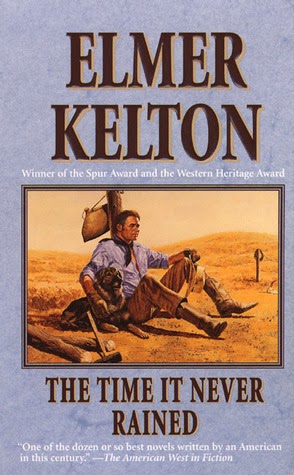
The Time it Never Rained, by Elmer Kelton (1973)


Howdy Book Mavens!

This month's discussion features one of the major works of Texas writer Elmer Kelton. It's Gem's pick, and accordingly she will preside over our conversation on Tuesday. Gem seems to be putting us through our paces on Texas born writers, witness our wonderful meeting with East Texas native, Joe R. Lansdale. This time around we explore the people and places on the opposite side of the state, West Texas, in Kelton's THE TIME IT NEVER RAINED.

Let's get together on a chilly night and warm our spirits with literature and literary talk. 

In related news, the list for 2015 is shaping up nicely! More on that later. But if you're considering picking a title, we need a few more titles by female authors. We have a selection for Black History Month, I will choose a poet for April, Paul has chosen a work by a Chinese dissident writer (banned), and Trudy has chosen a book of short fiction. That leaves the field clear for whatever you might like to choose. More suggestions?

Discussion Questions

1. Borrowing from Paul’s question about Alice Munro’s Canada, is there anything that makes this book specifically Texan? Conversely, does it transcend regionalism or speak to greater truths?

2. We all bring a personal history to our reading which determines if a book “speaks” to us. Did this book speak to you? If so, what did it say?

3. A host of diverse characters inhabit Rio Seco. Are they believable in their identities and in their relationships to each other?

4. The Texas drought of the 1950s lasted seven years. In 2011, East Texas along with the entire state was in severe drought. How did it affect you? Or did it? Here are two websites that speak about drought in Texas.

http://twri.tamu.edu/publications/txh2o/fall-2011/the-time-it-never-rained/http://waterdatafortexas.org

5. Colloquialisms are sprinkled liberally throughout the narrative. Did they enhance or detract from the story? Did you have any favorites?

6. Charlie endures. Does “The Time It Never Rained” resonate Faulkner’s comments?http://www.nobelprize.org/nobel_prizes/literature/laureates/1949/faulkner-speech.html

Thursday, October 16, 2014

Runaway, by Alice Munro (2004)

Just as a swimmer, who with his last breath
flounders ashore from perilous seas, might turn
to memorize the wide water of his death --
so did I turn, my soul still fugitive
from death's surviving image, to stare down
that pass that none had ever left alive.
from Dante's Inferno

I came upon a child of God
He was walking along the road
And I asked him, where are you going
And this he told me
I'm going on down to Yasgur's farm
I'm going to join in a rock 'n' roll band
I'm going to camp out on the land
I'm going to try an' get my soul free
We are stardust
We are golden
And we've got to get ourselves
Back to the garden
from Woodstock, by Joni Mitchell


Howdy All,

As we prepare for the last two titles in this reading year, RUNAWAY, by Alice Munro (Paul) and THE TIME IT NEVER RAINED, by Elmer Kelton (Gem), I would like to take this opportunity to urge each of you to begin considering your pick for next year's list. That is, assuming you haven't already nailed that down! As in the past, I would prefer to have the list and its accompanying schedule completed by November first. Does this mean that the annual harassment of members for titles is upon us? But of course!

Please bear in mind the yearly categories of short fiction, banned book, poetry, Nat'l Black History Month, and sub-cultural/international title. Also, attention should be paid to insuring a solid representation of female writers. Beyond these areas, the sky's the limit! I would also send a special appeal to anyone who has not led a discussion for a while, as well as anyone who has yet to choose a book. Please, share with us your insight and your interests. In this way we'll continue to give voice to the diversity and depth of the best book club in all East Texas. So. My pen/cursor is poised to note your suggestions for 2015. I know that we'll all be challenged and delighted by your suggestions.

Also, this might be a good time to start considering where we might like to have our annual holiday party. Ideas on this would be appreciated. For instance we might consider whether we want to hold the party in one of our homes, or at a restaurant or other public venue. Thoughts?

Paul Cronemeyer presides on Tuesday night. See you there.

Saturday, September 13, 2014

All My Sons, by Arthur Miller (1947)

All My Sons -- Discussion Questions


1. Many have pointed out that reading a book is a much more interactive process that watching a movie or a play, because the reader creates her own mental version of the characters, the setting, the action, etc. from the writer's descriptions while the watcher simply has to accept the version provided. Reading a play can require even more imagination, because the descriptions given of the characters, setting and action are often much more sparse. Many book authors describe settings in extreme detail and novelists often give us direct insight into the thoughts and motivations of characters. In a play the detail of setting is often left to the imagination of the set designer and conveying the emotions and motivations of the characters is often largely left to the craft of the actors and director. Does having to supply so much information yourself work for you as a play-reader? In other words, does the experience seem richer, weaker, more difficult, more challenging, etc. when compared to reading a novel?


2. I understand James "beat me to it" by selecting the first and only other play for FHBC consumption -- The Merchant of Venice. How did your experience reading a Shakespeare classic differ from reading what many consider a modern classic? What do you gain or lose moving from Shakespeare's use of language compared to the more straight-forward language of Miller's characters? Although different in language and structure, do you see any parallels between Shakespeare and Miller?


3. a) I chose Miller because he is considered a modern master and because his works have been banned --- it is Banned Book Month, after all. In 1970, Miller's works were banned in the Soviet Union after he campaigned for the freedom of dissident writers. Any comments on the irony of the Soviet Union banning Miller?


b) I chose All My Sons because it is much less well known than Death of a Salesman or The Crucible which many of us read for school or have seen portrayed on stage or screen. All My Sons was Miller's first real success. It was written and produced for the Broadway stage in the late 1940s. What are the themes of the play and do they still resonate today?


4. Were any scenes or characters particularly impactful or memorable to you? Why? Did any development in the story surprise you?


5. (SPOILER ALERT!) Why does Joe Keller kill himself?


6. Did you like the play?


Sunday, September 7, 2014

The BBC Book List of Top 100 Books


The BBC posted that most people will have only read 6 of the 100 books here. How do your reading habits stack up? Comments anyone?

Copy, edit and paste into a note of your own.

Sunday, August 24, 2014

What the Internet is Doing to Our Brains, by Nicholas Carr

"Between the intellectual guardrails set by our genetic code, the road is wide, and we hold the steering wheel. Through what we do and how we do it--moment by moment, day by day, consciously or unconsciously--we alter the chemical flows in our synapses and change our brains."~Nicholas Carr

"We must always be on the lookout for perverse dynamic processes which carry even good things to excess. It is precisely these excesses which become the most evil things...The devil, after all, is a fallen angel."~Kenneth E. Boulding

"We become what we behold. We shape our tools, and thereafter, our tools shape us."~Marshall McLuhan

"IT'S ALIVE, IT'S ALIVE!"~ Victor Frankenstein (Mary Shelley)


Hello Book Mavens,

This month's selection has been a real eye-opener for this reader, and I suspect that it will have made quite an impression on most, if not all of you as well. Nothing could be of more import to those as deeply invested in the benefits and pleasures of reading as we are. So, when I chanced upon the original article in the Atlantic that gave rise to the expanded book that I chose for this month, I greedily devoured it. Carr's book, at least for me, has filled out a chilling picture that may bode ill for the future prospects of book culture.

As I read, fascinated with the cultural shifts described by the author, and the startling results of many scientific experiments backing up his claims, I felt the same concern that I experienced many years ago when the first e-readers were coming onto the scene. Now, having been given an e-reader as a gift a few years back (I doubt I would ever have bought one for myself), I sense the same foreboding described by Carr as sitting on the cusp of a tectonic paradigm shift in culture. As the author described it near the beginning of his book, "My life, like the lives of most Baby Boomers and Generation X'ers, has unfolded like a two-act play. It opened with Analogue Youth and then, after a quick but thorough shuffling of props, it entered Digital Adulthood."

I have a feeling that our discussion on Tuesday night August 26, at the home of Jay and Jessica Noble, will be as lively a conversation as we've had all year. In case you haven't gotten the e-mails about the meeting re-location, the Nobles live at 229 Bridgers Hill Rd, Longview. We look forward to seeing you all there.


DISCUSSION QUESTIONS